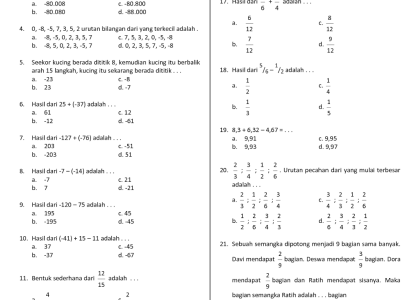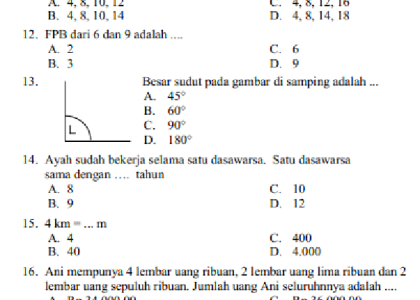

Mathematics, often perceived as a challenging subject, plays a pivotal role in shaping a child’s cognitive development and problem-solving skills. For fourth graders in Indonesia, navigating the landscape of mathematics under the 2013 Curriculum (Kurikulum 2013) presents a unique set of learning objectives and assessment methodologies. This article aims to provide a comprehensive overview of fourth-grade mathematics within this curriculum, focusing on key concepts, the pedagogical approach, and the types of problems students are expected to solve, all presented in English for a broader understanding and accessibility.
The 2013 Curriculum in Indonesia emphasizes a scientific approach to learning, encouraging students to observe, question, experiment, associate, and communicate. In mathematics, this translates to a more hands-on, inquiry-based, and contextualized learning experience. The goal is not just rote memorization of formulas but a deep understanding of mathematical concepts and their application in real-world scenarios. For fourth graders, this means moving beyond basic arithmetic and delving into more complex operations, fractions, decimals, geometry, and data analysis.
Key Mathematical Concepts for Fourth Graders under the 2013 Curriculum:
The fourth-grade mathematics curriculum is structured to build upon the foundational knowledge acquired in earlier grades. The core areas of focus include:
-
Number and Operations:
- Multiplication and Division: Students are expected to master multiplication and division of whole numbers, including multi-digit multiplication and division with remainders. They should understand the relationship between multiplication and division and be able to solve word problems involving these operations. For instance, problems might involve calculating the total number of items when given the number of groups and items per group, or determining how many groups can be formed from a total number of items.
- Fractions: This is a significant area of focus. Students learn to identify, represent, and compare fractions. They are introduced to equivalent fractions, adding and subtracting fractions with like denominators, and understanding fractions as parts of a whole or parts of a set. Word problems will often involve scenarios like sharing a pizza, measuring ingredients, or dividing objects.
- Decimals: Building on fractions, students are introduced to decimals, particularly those with one or two decimal places. They learn to read, write, and compare decimals and understand their relationship to fractions. This often involves money-related problems or measurements.
- Place Value: While introduced earlier, fourth graders deepen their understanding of place value up to thousands or even millions, enabling them to read, write, and compare large numbers.
-
Measurement:
- Length, Weight, and Time: Students learn to measure and compare various units of length (e.g., centimeters, meters, kilometers), weight (e.g., grams, kilograms), and time (e.g., seconds, minutes, hours, days). They will solve problems involving conversions between units and calculating elapsed time.
- Area and Perimeter: This is a new and crucial geometric concept. Students learn to calculate the perimeter of simple shapes (squares, rectangles) and understand the concept of area, initially for squares and rectangles. They will solve problems that require finding the space enclosed by a shape or the distance around it.
-
Geometry:
- 2D Shapes: Students identify and describe properties of two-dimensional shapes, including their sides, angles, and vertices. They are introduced to concepts like parallel and perpendicular lines.
- 3D Shapes: Students are exposed to basic three-dimensional shapes like cubes, cuboids, cones, and cylinders, identifying their faces, edges, and vertices.
-
Data Analysis and Probability:
- Data Representation: Students learn to collect, organize, and represent data using bar graphs and pictographs. They should be able to interpret the information presented in these graphs to answer questions.
- Basic Probability: While not a heavy focus, students might be introduced to simple probability concepts through scenarios like coin flips or dice rolls.
The Pedagogical Approach: Learning by Doing and Understanding
The 2013 Curriculum advocates for a learner-centered approach. In mathematics, this means:
- Contextualization: Problems are often framed within real-world situations that are relatable to children. This helps them see the relevance and purpose of mathematics beyond the classroom. For example, instead of abstractly solving $2/3 + 1/3$, a problem might ask about combining portions of a cake.
- Inquiry-Based Learning: Students are encouraged to explore mathematical ideas, make conjectures, and discover patterns. Teachers act as facilitators, guiding students through their investigations rather than simply delivering information.
- Collaborative Learning: Group work and discussions are common, allowing students to learn from each other, articulate their thinking, and develop communication skills.
- Use of Manipulatives and Visual Aids: Concrete objects, drawings, and diagrams are extensively used to help students visualize abstract mathematical concepts. For fractions, this could be fraction tiles or drawings of pizzas. For geometry, it might involve using blocks or drawing shapes.
- Problem-Solving as a Core Skill: The emphasis is on developing problem-solving strategies. Students are taught to break down problems, identify relevant information, choose appropriate operations, and check their answers.
Types of Math Problems Fourth Graders Encounter:
The problems encountered by fourth graders are designed to assess their understanding of the concepts and their ability to apply them. Here’s a breakdown of common problem types:
-
Procedural Fluency Problems: These problems assess a student’s ability to perform mathematical operations accurately and efficiently.
- Example: Calculate $567 times 8$.
- Example: Solve $1234 div 5$.
- Example: Find the sum of $3/8 + 2/8$.
-
Conceptual Understanding Problems: These problems require students to demonstrate their grasp of mathematical ideas and relationships.
- Example: Explain why $1/2$ is equivalent to $2/4$. Use a drawing to support your explanation.
- Example: What is the difference between area and perimeter? Give an example of when you would need to measure each.
- Example: If a fraction has a numerator of 5 and a denominator of 7, what does each number represent?
-
Problem-Solving Word Problems: These are the cornerstone of the 2013 Curriculum, integrating mathematical concepts into real-life scenarios.
- Example (Multiplication/Division): A school library has 15 shelves, and each shelf can hold 85 books. How many books can the library hold in total? If the library wants to display 1,200 books, how many shelves would they need, assuming each shelf is filled to capacity?
- Example (Fractions): Sarah ate $1/4$ of a pizza, and her brother Tom ate $2/4$ of the same pizza. What fraction of the pizza did they eat altogether? How much pizza is left?
- Example (Decimals/Money): A pen costs Rp 3,500, and a notebook costs Rp 7,250. If you buy one pen and one notebook, how much will you pay in total? If you pay with a Rp 15,000 bill, how much change will you receive?
- Example (Measurement/Time): A movie starts at 10:15 AM and lasts for 1 hour and 45 minutes. What time will the movie end?
- Example (Area/Perimeter): A rectangular garden has a length of 10 meters and a width of 5 meters. What is the perimeter of the garden? What is the area of the garden?
-
Data Interpretation Problems: These problems involve analyzing information presented in graphical formats.
- Example: A bar graph shows the number of students who prefer different fruits: Apples (15), Bananas (20), Oranges (12), Grapes (18). How many students prefer bananas? Which fruit is the least popular? How many more students prefer apples than oranges?
Challenges and Strategies for Success:
While the 2013 Curriculum aims for a more engaging and effective learning experience, some challenges may arise:
- Abstract Concepts: Fractions and decimals can be abstract for some students. The emphasis on visual aids and real-world examples is crucial here.
- Word Problem Comprehension: Students may struggle to understand the context of word problems or identify the relevant mathematical operations. Teachers often employ strategies like "Read, Understand, Plan, Solve, Check" to guide students.
- Bridging the Gap: For students who may have had a different educational background, adapting to the inquiry-based approach might require extra support.
To ensure success, several strategies can be employed by educators, parents, and students:
- Consistent Practice: Regular practice of a variety of problem types is essential for building fluency and confidence.
- Active Engagement: Encourage students to ask questions, participate in discussions, and explain their reasoning.
- Use of Resources: Utilize textbooks, online resources, educational games, and manipulatives to reinforce learning.
- Real-World Connections: Continuously highlight how mathematics is used in everyday life.
- Positive Reinforcement: Celebrate effort and progress, fostering a growth mindset.
- Individualized Support: Identify students who need extra help and provide targeted interventions.
Conclusion:
The fourth-grade mathematics curriculum under the 2013 Curriculum in Indonesia offers a robust framework for developing mathematical proficiency. By focusing on conceptual understanding, problem-solving, and real-world applications, it aims to equip students with the skills and confidence needed to tackle increasingly complex mathematical challenges. The emphasis on a scientific and learner-centered approach ensures that learning is not just about memorizing facts but about fostering a genuine understanding and appreciation for the power of mathematics in shaping their world. By embracing the pedagogical principles and engaging with the diverse types of problems, fourth graders can embark on a successful and enriching mathematical journey.